

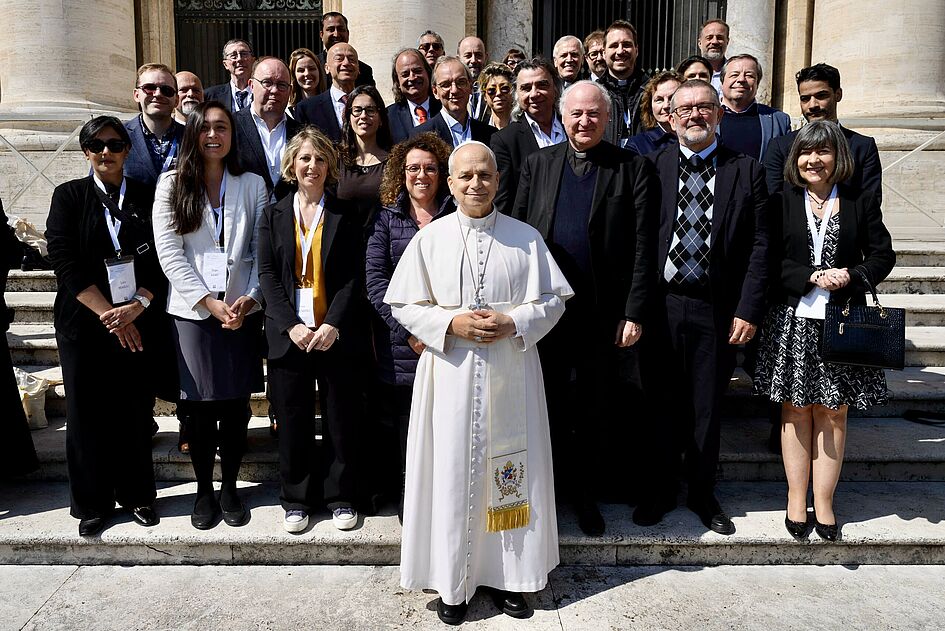
The 3rd International Conference on the Ethics of Engineering Life (iceel.info), held in Rome in March 2026, brought together an exceptionally diverse international community to reflect on one of humanity’s most enduring and pressing questions: Quid est homo? Quis est homo? — What is the human being? Who is the human being?
This ancient dual question formed the conceptual core of the conference. It captures a fundamental distinction: while the natural sciences increasingly illuminate what the human being is in terms of structure, function, and biological mechanisms, the question of who the human being is — as a subject of dignity, responsibility, identity, and meaning — necessarily exceeds the scope of any single discipline. ICEEL 2026 was designed precisely as a space in which these perspectives could meet. This dialogue unfolded not only among approximately 40 invited participants on site in Rome but was extended to a global audience of more than 300 online participants from 46 countries, underscoring the worldwide relevance of the questions addressed.
Over the course of two days, leading voices from engineering life sciences, philosophy, ethics, theology, and the humanities engaged in an intensive and genuinely dialogical exchange. The conference format centered on moderated panels rather than isolated lectures. It fostered encounters across disciplinary boundaries and encouraged a shared exploration of the ethical implications of rapid developments in molecular engineering, regenerative medicine, and data-driven biomedical innovation.
A central theme that emerged throughout the conference was the growing need for shared ethical frameworks capable of addressing responsibility, accountability, and the societal impact of technological innovation. In her keynote on robotics and artificial intelligence in the life sciences, Prof. Maria Chiara Carrozza emphasized the urgency of developing such guidelines in light of increasingly autonomous and interventionist technologies.
The thematic breadth of ICEEL 2026 was further reflected in contributions such as Prof. Telmo Pievani’s bioethical critique of de-extinction, which raised fundamental questions about human agency, technological ambition, and the limits of intervention in evolutionary processes. Additional panel discussions addressed topics including human consciousness, embodiment, spirituality, communication, and the evolving relationship between scientific knowledge and human self-understanding. Notably, these discussions brought together not only internationally recognized scientists but also early-career researchers, representatives of the humanities, and voices from patient organizations — underscoring the conference’s commitment to inclusivity and societal engagement.
In addition, the conference highlighted the essential contributions of major religious traditions to the ethical reflection on the human person, particularly within the panel on spirituality. Closely connected to this, the role of communication and mass media — addressed in a dedicated panel — emerged as a crucial dimension for responsibly conveying scientific knowledge and shaping public understanding. A distinctive and defining feature of ICEEL 2026 was the integration of the arts as an essential component of ethical reflection. Artistic contributions were not conceived as accompanying events, but as keynotes in their own right — offering alternative and complementary modes of understanding the human condition. The conversation with renowned Canadian filmmaker David Cronenberg on Human Body and Cinema explored the shifting boundaries between body, technology, and identity, opening a space of reflection that resonated deeply with the conference’s central themes.
Equally powerful was the concert When Sound Becomes Dialogue, performed by Ukrainian pianist Alexey Botvinov and Turkish percussionist Burhan Öçal in the Sala Assunta in the Vatican Gardens. Here, music became a form of philosophical inquiry — an experiential language through which questions of human existence, difference, and resonance could be explored beyond conceptual discourse. Both events elevated the conference dialogue to a different level, demonstrating that the question of what and who we are cannot be addressed through analysis alone, but requires forms of encounter that engage perception, emotion, and imagination.
The conference concluded with a meeting between participants and Pope Leo XIV — a symbolic and meaningful moment that underscored the broader societal and spiritual relevance of the questions discussed.
While ICEEL 2026 did not — and could not — provide definitive answers to the questions of quid and quis, it succeeded in something equally important: creating a transdisciplinary space of dialogue in which these questions could be approached with intellectual rigor, openness, and mutual respect. The conference demonstrated that meaningful engagement with the ethical challenges of engineering life requires not only scientific excellence, but also sustained dialogue across disciplines, cultures, and forms of knowledge.
In this sense, ICEEL 2026 marks an important step toward a more integrated understanding of the human being — one that recognizes that the question of what we are can never be fully separated from the question of who we are.
ICEEL 2026 was jointly organised by the Art of Molecule (AoM) ethics initiative, the NCCR Molecular Systems Engineering (Switzerland), the Pontifical Academy for Life, and the Bambino Gesù Children’s Hospital in Rome.
Dr. Ralf Stutzki Renzo Pegoraro
AoM/NCCR MSE Pontifical Academy for Life